
Weighing out small amounts is always nerve-racking. Between a shaky hand, an unwelcomed breeze or a scale full of static, there are plenty of ways for your precious few milligrams of material to vaporize into thin air. As a result, it is often tempting to get the solid into the “safer” heavier flask where at least it will be protected. However, this is not always the best idea.
Five Ways Scientists Waste Time
by
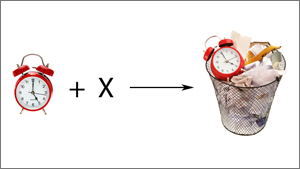 Notice the title is not “The only 5 ways scientists waste time…” Labs can be filled with a million distractions, and these days most of them reside on the internet. But we’re not talking about killing two hours on Hot or Not. We’re talking about how we waste time when we don’t know we’re wasting time. Those are the killers. And these days, with funding tight and postdocs seeming to stretch into oblivion, wasting time can have serious consequences.
Stealing Projects, Surviving Gross Experiments and Deceit
by
 Welcome to my first column! I am very excited to have the opportunity to contribute to BenchFly, and I look forward to answering your questions! I welcome all ideas, questions and comments and thanks to Sarah, Chris and Dave for helping kick off the series!
BenchFly Buzzes into Labs Worldwide to Help Scientists Soar
by
BENCHFLY BUZZES INTO LABS WORLDWIDE TO HELP SCIENTISTS SOAR
Researchers Can Share, Watch and Learn Life and Laboratory Techniques Now on BenchFly.com
CAMBRIDGE, Mass. – October 5, 2009 – BenchFly™, Inc. today announced the official launch of BenchFly.com, a website that integrates life and laboratory techniques in order to make research a better career today and for future generations of scientists. On a daily basis, BenchFly.com expands scientific learning through free online science videos, current protocols and lab techniques while empowering researchers to better navigate their lives both in and out of the lab through career and personal development content.
BenchFly founder and third-generation scientist Alan Marnett, PhD founded BenchFly as a postdoctoral fellow at the Massachusetts Institute of Technology (MIT). During his 15 years working as a bench scientist, he observed that the quality of scientific training and research varied dramatically from laboratory to laboratory, even within the same institution. Variables such as mentorship, funding and access to information significantly impact the individual researchers whose successes make or break a lab’s potential contributions. Dr. Marnett started BenchFly to repair this disconnect, foster improved collaboration and remove the obstacles that impede scientific progress.
“Whether in a small lab, in a small university, or in a big lab at a large institution that’s empty at 3 a.m., researchers worldwide should have access to expert instruction anywhere, anytime at the click of a mouse. I started BenchFly to democratize scientific resources, including the quick yet essential tips and tricks that can turn a good scientist into a great one. BenchFly provides scientists with the tools they need to solve the problems they face everyday in lab. Think of us as one of your labmates, except we don’t fall asleep in group meeting,” said Marnett who is also BenchFly’s CEO.
Through both written and video content BenchFly addresses the complexities of the lives of researchers and the challenges they face everyday at the bench. The stereotype that scientists are socially inept and reclusive has never reflected the virtues of successful scientists. In fact, the modern scientist must be both dynamic and collaborative to facilitate groundbreaking discoveries. By engaging scientists with honesty and humor, BenchFly provides researchers with the community and tools they need to develop both professionally and personally.
“BenchFly has been a great resource in my lab not only for learning techniques but also for providing advice and resources for many of the other issues that face bench scientists,” said Matthew Bogyo, PhD, a Stanford University professor conducting cancer research. “Perhaps as important to my students and post-docs is the fact that BenchFly is presented in a funny and entertaining way that builds on the experiences and testimonials of other scientists at similar career stages.”
“As a graduate student, I sometimes feel overwhelmed by how much I have to learn about science, both on a daily basis for my research and long-term for my own career,” said Rachel Schecter, a fourth year graduate student looking at the molecular mechanisms of learning and memory at MIT. “BenchFly is like that senior lab member who I can turn to for advice on how to optimize my experiments and offer guidance on the issues that are specific to lab life.”
“The new gold standard for gauging the impact of social media today is about much more than just the number of followers you have. It’s about the quality and value of the content you share. BenchFly is a great example of an online community built to solve a specific problem—how to support the researchers that are the foundation of science,” said Peter Pezaris, founder and CEO of Multiply.com, a leading social networking site with more than 16 million users.
BenchFly’s approach to supporting researchers and catalyzing scientific progress online includes three specific aims:
- Expand Scientific Knowledge Through Researcher-Generated Content: First-hand demonstrations are the way scientists learn in lab. With researcher-developed science videos, BenchFly provides expert instruction to any scientist with an Internet connection worldwide.
- Daily Career and Personal Development Guides for Scientists: Being a scientist is much more than just mixing chemicals, making discoveries and avoiding explosions… it’s a lifestyle. Whether highlighting the latest laboratory techniques, discussing career opportunities or providing personal organization advice, BenchFly shares the latest tips and tricks to master and balance life while at or away from the bench.
- Reinvent the Image of the Scientist: The pocket protector is dead. BenchFly knows science is an exciting, cutting-edge profession made up of intelligent, humorous, creative and passionate individuals. It’s time scientists share that passion with society to energize future generations of scientists and ensure the future of the craft remains bright.
To learn more about our mission, please view the BenchFly welcome video. For additional information, please visit BenchFly.com.
About BenchFly, Inc.
BenchFly integrates life and laboratory techniques in order to make research a better career today and for future generations of scientists. By engaging scientists with honesty and humor, BenchFly provides researchers with the community and tools they need to develop both professionally and personally. Through free and researcher-generated content such as online science videos, current protocols, laboratory techniques and career and personal development advice, BenchFly empowers scientists to overcome the challenges they face in lab everyday to enable their next big breakthroughs, faster. Founded in Cambridge, Mass. by an MIT post-doc, Alan Marnett, PhD, in 2009, BenchFly, Inc. is privately held. Visit us at stage.benchfly.com.
BenchFly is a trademark of BenchFly, Inc.
Contact:
Please email us at: [email protected]
.
Dear Dora: Introducing Dora Farkas, Ph.D.
by
 We are very excited to announce a new segment at BenchFly called “Dear Dora,” a monthly advice column featuring Dora Farkas, Ph.D., author of “The Smart Way to Your Ph.D.: 200 Secrets from 100 Graduates.” Here, we introduce Dora by peppering her with questions, like any good scientist would…
What Influences Your Research?
by
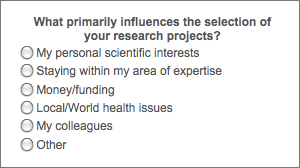 As researchers, we work at the forefront of knowledge, exploring processes and phenomena currently beyond our understanding. Therefore, it seems our research projects could pursue almost limitless avenues. So what drives us to move in one direction over another?
The Importance of Sterile Technique
by
Messing up your own experiments is one thing. Messing up an entire lab’s is a whole nother. One of the easiest ways to make a large group of people furious with you instantly is to contaminate the incubator. It’s the equivalent of lighting their experiments on fire – they should be mad. The bad part is, it’s your fault. The good part is, it’s completely avoidable…
The Keys to a Great Hypothesis
by
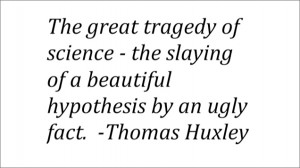 A great hypothesis is the foundation upon which great experiments may be designed and carried out. Hypotheses ultimately help us to make sense of the experimental data we observe. Non-hypothesis-driven research, we are often told, is a reckless fishing expedition that relies on luck and is not how research should be performed. Interestingly, the opposite of this criticism is the biggest danger of working with a hypothesis.
Stay Motivated in Lab
by
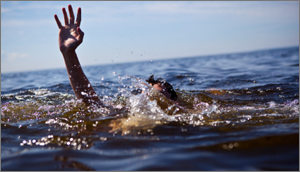 Science can be like Baywatch. Well, there are decidedly fewer bikinis and speedos, but there are similarities. Specifically, there are times when all of us feel like we’re drowning. Learning how to stay motivated in lab through the natural ebb and flow of good results is an essential skill for becoming a successful scientist.
Are We Failing Our Graduate Students?
by
 In a recent article, “Finding a Partner for Your Ph.D.,” the AAAS/Science Business Office provided advice to prospective graduate students. They start by presenting horrifying graduation rate data (that their target audience probably shouldn’t even see…). Even scarier is their interpretation of what these data indicate. Regardless of how you interpret it, the bottom line is that we’ve got some serious problems.
